First, notice the contour
Clear, elastic outlines lock figures, fabric and natural forms into printable planes.
Complete free archive
Ukiyo-e uses woodblock flat color, clear contours, bold composition and everyday subjects to depict Edo-period urban entertainment, landscapes, beauties and actors.
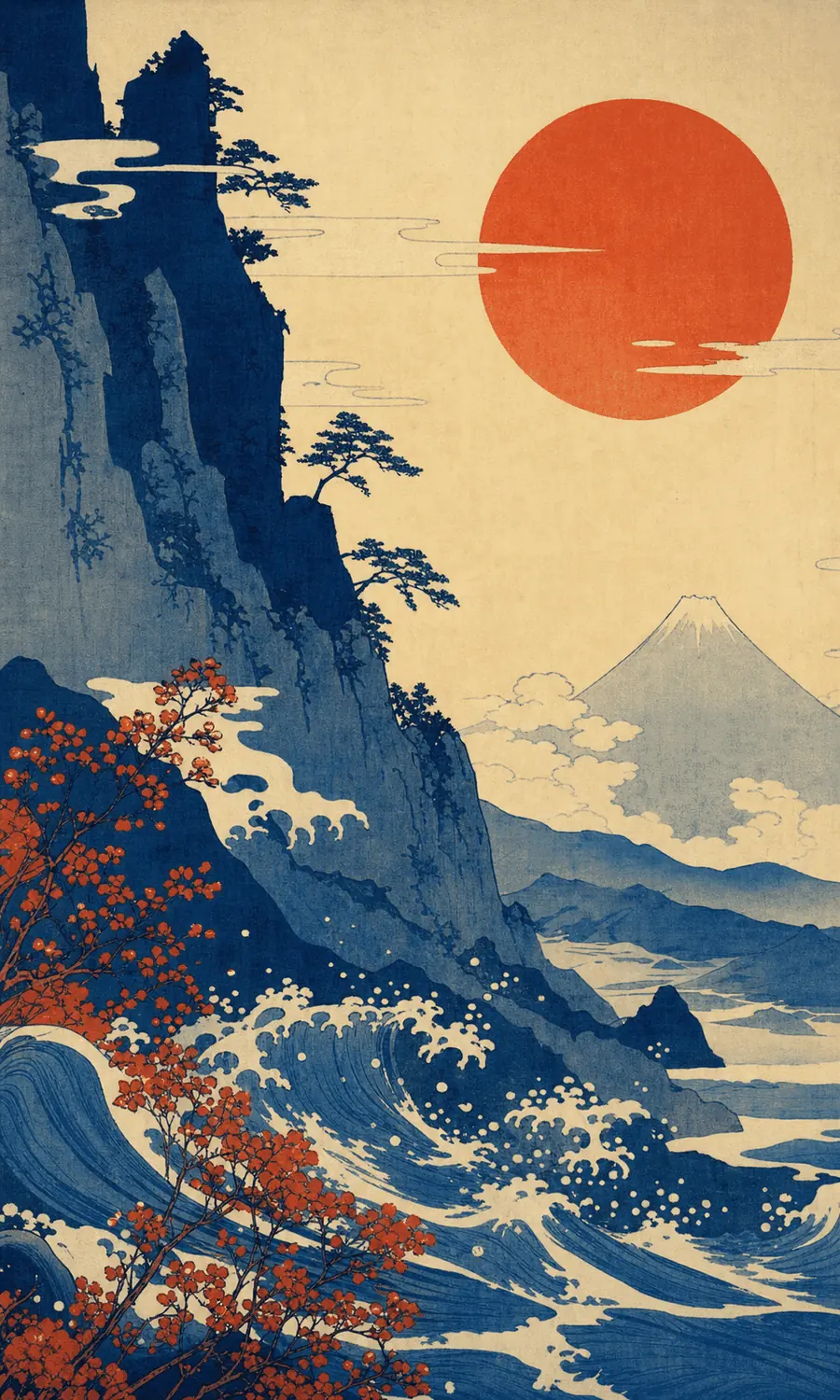
Notice how outlines divide the image into planes: do figure, wave, sky and lettering feel fitted together?
Clear, elastic outlines lock figures, fabric and natural forms into printable planes.
Subjects may be cut by the frame, foregrounds enlarged and distances compressed, creating a snapshot-like viewpoint.
Color relies less on modeled light and more on flat areas, pattern and relationships between printed layers.
These are comparative observation levels, not ratings of artistic value or quality.
Read contour and color fields first, then cropping. Waves, bridges, mountains and figures are arranged graphically rather than filling space through Western perspective.
Its flat color and strong contour come from woodblock production, with designer, carver and printer working together. Clear color fields and bold cropping make the image powerful even as a printed edition.
Like a wave carved into paper by woodblock: flat, precise and rhythmic.
In prints, screens or textiles, notice how large color areas and repeated patterns create clear boundaries.
Let one strongly patterned item lead, with the remaining colors drawn from that pattern.
Let a foreground object block part of the frame or crop at the edge to suggest passing movement.
See how packaging, tableware and fabric use contour, flat color and small patterns to tell a compact scene.
Shared qualities: Both use flat color, narrative scenes and Japanese subject matter.
Different choices: Yamato-e often serves courtly handscrolls and continuous classical narratives; Ukiyo-e comes from urban publishing and woodblock circulation, with bolder crops and more direct everyday subjects.
Shared qualities: Both value flowing contour, flat composition and pattern.
Different choices: Ukiyo-e compresses space through woodblock color and bold cropping; Art Nouveau translates those influences into botanical curves, total borders and European decorative design.
Ukiyo-e woodblock-style original poster, flat color fields, clear black contour, indigo cream vermilion palette, bold cropping, wave or bridge with distant mountain, paper texture, registration print feel, not copying The Great Wave or a specific work
Avoid modern anime faces, photorealism, complex gradients, random kanji gibberish, direct copy of a Hokusai or Hiroshige composition
Ukiyo-e flourished in Japan's Edo period through urban consumption, woodblock printing and publishing. It depicted the floating world of entertainment, kabuki, famous places and daily life, later influencing Impressionism, Post-Impressionism and Art Nouveau in Europe.
Do you prefer its clear flatness, or the movement created by its bold cropping?