Follow the curve
Stems, hair, drapery and lettering often share one undulating line that carries the eye across the image.
Complete free archive
Art Nouveau uses vine-like curves, flowers, female figures and crafted ornament to turn posters, architecture, jewelry and books into one flowing natural pattern.
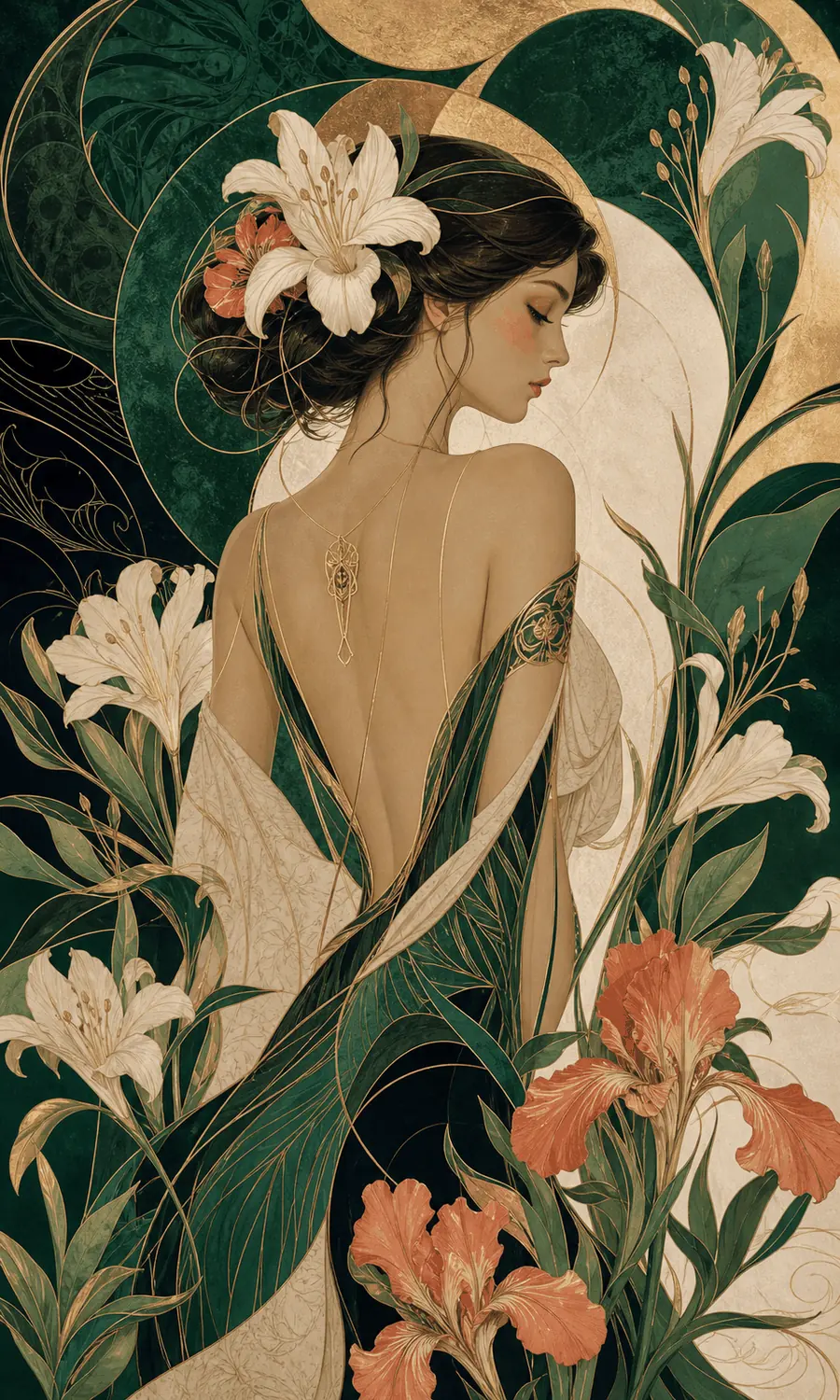
Follow the longest curve: does it grow like a plant, or wrap the whole image together like a frame?
Stems, hair, drapery and lettering often share one undulating line that carries the eye across the image.
Figure, plant and type interlock with edges and empty spaces instead of sitting as separate pieces.
Leaves and flowers are stretched, repeated or simplified into pattern, retaining growth without becoming botanical illustration.
These are comparative observation levels, not ratings of artistic value or quality.
For Art Nouveau, follow the line. If the first thing you notice is not an object but a continuous curling contour, you are close.
It wanted modern life to regain an organic handmade feeling. Lines do not move straight; they curl like leaves, hair and water. Ornament is not pasted on; it grows with figure, type and frame.
Like a plant growing into the poster frame, its lines flowering around the figure.
See how a curve travels from structure into detail across railings, mirrors and lamps rather than appearing as an applied motif.
Notice how drape, long lines and botanical jewelry make a continuous silhouette without competing focal points.
Use branches, arches or hair as a natural frame that leads the eye toward the subject.
Look at book covers, glassware and ironwork to see whether letters and motifs seem to grow from one plant.
Shared qualities: Both extend a complete decorative language across posters, buildings and objects.
Different choices: Art Nouveau relies on botanical curves, asymmetric growth and craft; Art Deco relies on clipped geometry, central axes and machine-age sheen.
Shared qualities: Both can show flat color, clear contour and bold cropping.
Different choices: Ukiyo-e comes from woodblock color and urban print culture; Art Nouveau redirects such flatness into European botanical ornament, lettering and total frames.
Art Nouveau illustration poster, vine-like curves, floral border, elegant female silhouette, hand-drawn ornamental lettering, soft natural palette, flat decorative composition, refined print texture, original poster, not copying a specific Mucha work
Avoid modern minimalism, rigid geometry, cheap floral clipart, oversexualized figure, copying a specific Mucha poster composition
Art Nouveau rose in Europe around the late 19th and early 20th centuries, rejecting recycled historic styles while responding to rough industrial mass production. It drew from plants, insects, Japanese prints, the Arts and Crafts movement and urban commercial posters.
Do the curves feel naturally expansive, or as if ornament is taking over every space?