Begin with body and plane
Faces, hands and small areas of skin often retain natural volume while dress and background flatten into continuous pattern, creating tension between two spaces.
Complete free archive
Klimt-like golden ornament fuses figures, gold leaf, mosaic patterns and symbolic motifs into a luxurious, mysterious decorative surface.
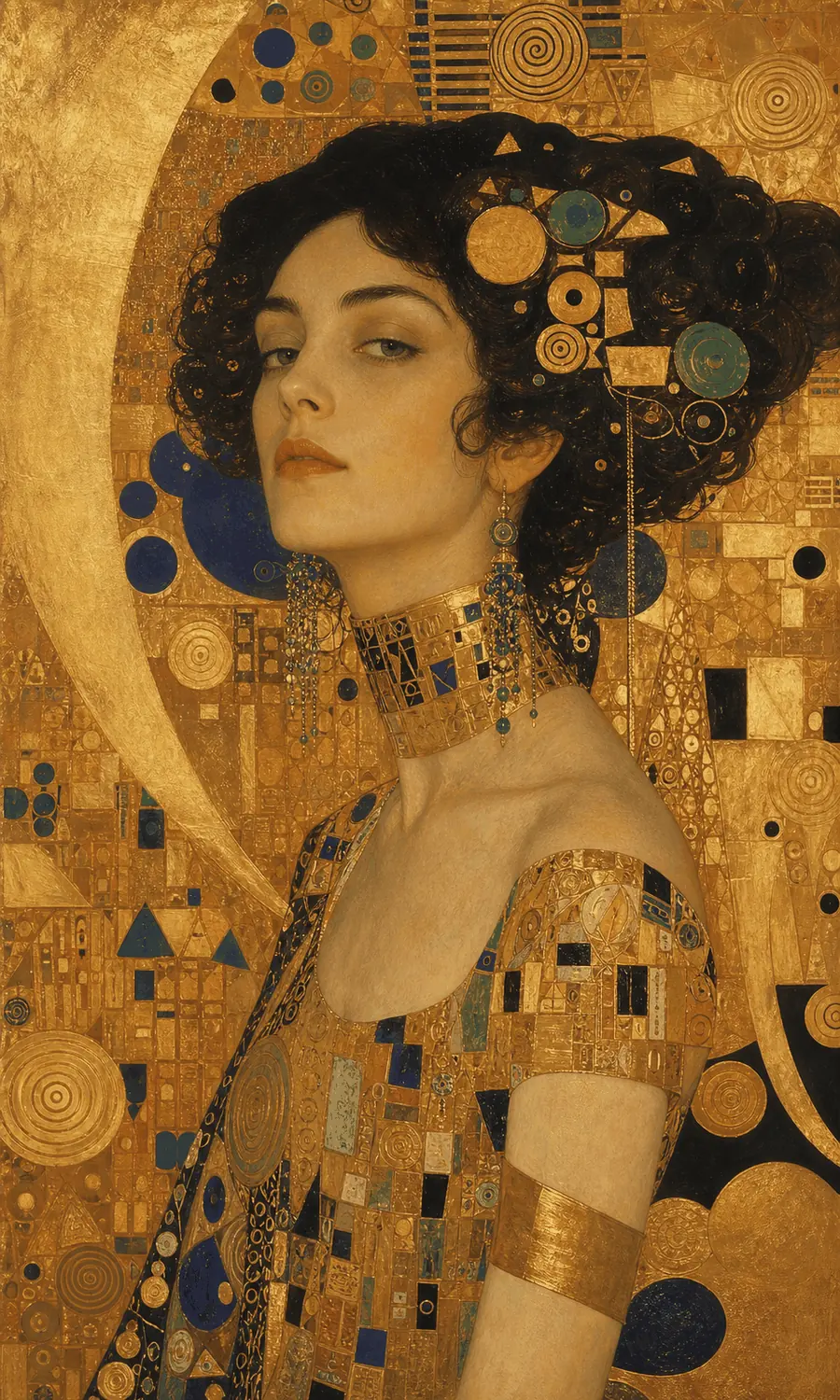
When face and hands retain volume but the body enters a field of gold pattern, does the person emerge or become enclosed by the surface?
Faces, hands and small areas of skin often retain natural volume while dress and background flatten into continuous pattern, creating tension between two spaces.
Gold, squares, circles and repeated small motifs create shimmer and reduce depth, though materials and density vary across works.
A flowing outer contour joins figure, clothing and ground, while gaze and posture preserve the sitter's individual presence.
These are comparative observation levels, not ratings of artistic value or quality.
Look for gold first, then count how many small patterns live inside it. The figure is not simply in front of a background; it is absorbed by a patterned world.
He brings bodily presence and flat ornament together: faces and hands remain realistic while clothing and background dissolve into golden signs, creating a border between reality and dream.
Like a person wrapped in golden mosaic and pattern until the body almost becomes an icon.
See how reflective surfaces, geometric textiles and portraits preserve hierarchy, allowing ornament to surround inhabitants without consuming them.
Attend to the tension between face, hands and patterned clothing, keeping bodily presence central rather than turning it into a pattern display.
Surround a sitter with a reflective or dense ground while keeping gaze, gesture and contour clearly present.
Examine how jewelry, book covers and boxes control density through repeated small forms, metallic reflection and limited open space.
Shared qualities: Both use flowing contour, botanical line and integrated decorative surfaces.
Different choices: Art Nouveau is a broad movement across architecture, posters, type and objects; Klimt's painting language focuses more specifically on tension between bodily volume and gold, mosaic-like planes.
Shared qualities: Both may show gold grounds, frontality, flatness and mosaic-like repetition.
Different choices: Byzantine icons belong to liturgical, devotional and specific image traditions; Klimt redirected related surface language into modern portraiture, allegory and Viennese visual culture.
Klimt-like golden decorative visual language, elegant original portrait, gold leaf texture, mosaic geometric patterns, floral and spiral symbols, realistic face with flat ornamental clothing, luxurious mysterious mood, high resolution, not copying a specific work or pose
Avoid directly copying The Kiss pose, cheap gold glitter filters, oversexualization, low-quality mosaic textures, screenshots of real artworks
Gustav Klimt was central to the Vienna Secession in late-19th- and early-20th-century Austria. He absorbed Byzantine mosaics, Symbolism, decorative art and modern Viennese culture, turning portraits into golden, patterned and psychologically charged worlds.
As ornament grows denser, do you still see the person first, or feel the distance between person and surface?