Begin with several viewpoints
Eyes, rims, tabletops or instruments combine frontal and side clues, breaking apart the authority of one fixed viewpoint.
Complete free archive
Cubism breaks an object into multiple viewpoints at once, rebuilding reality with flat facets, structural lines and restrained color.
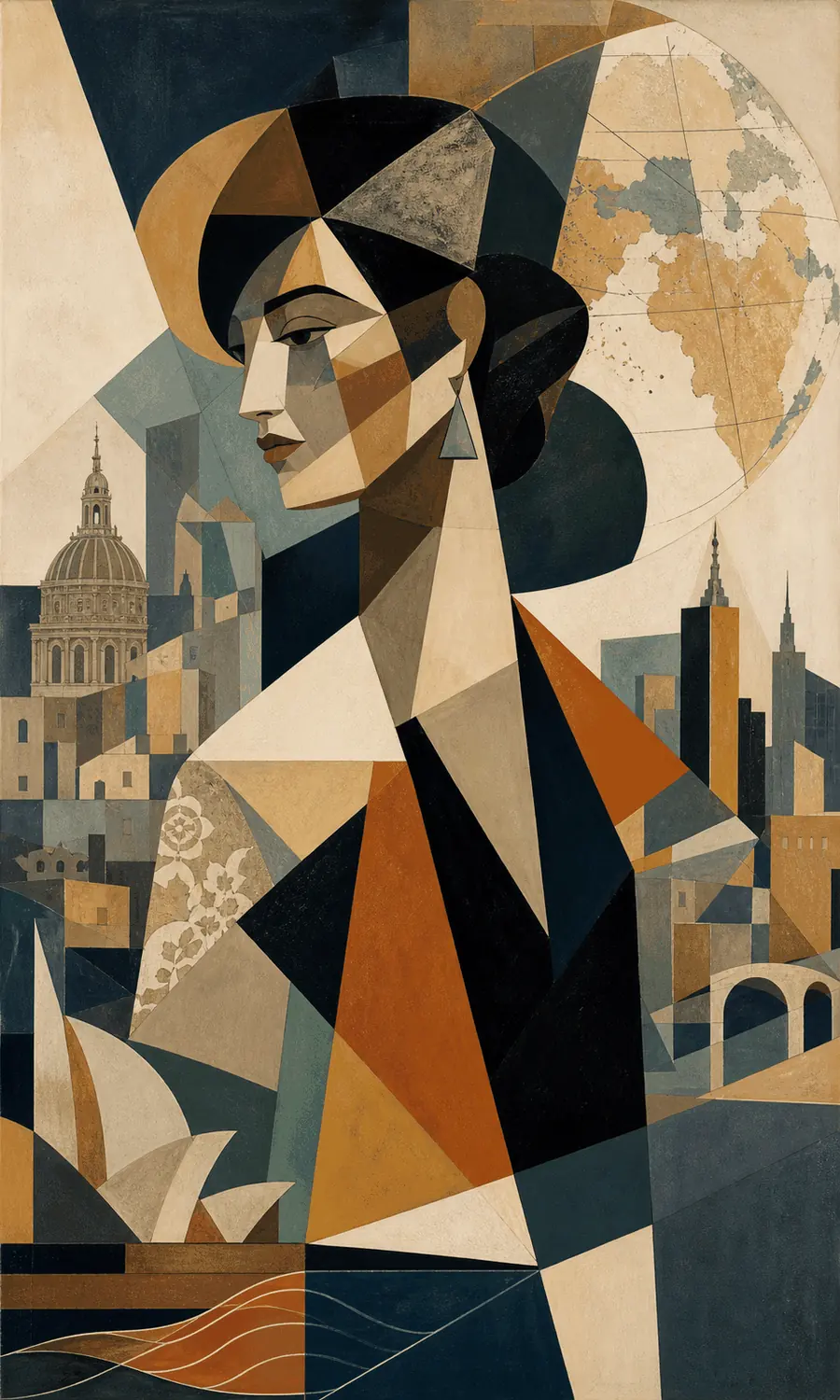
If front, side and interior appeared at once, which fragment would let you recognize the object again?
Eyes, rims, tabletops or instruments combine frontal and side clues, breaking apart the authority of one fixed viewpoint.
Object edges and background planes interlock; gaps stop being leftover space and become active parts of the construction.
Newspaper, wallpaper, wood grain or fragments of type can enter directly, making actual material and represented object question one another.
These are comparative observation levels, not ratings of artistic value or quality.
Do not first ask whether it looks accurate. Ask how several viewpoints coexist. Noses, eyes, tables and instruments often become structural fragments.
It argues that reality is not one angle. Objects can be split, rotated and flattened so viewers see form, time and the act of looking together.
Like breaking a face into mirrors and rebuilding it from front, side and memory at the same time.
Observe one room from doorway, table and mirror, comparing how shapes from different angles combine in memory.
See how seams, layers and front-side contours divide the body into connected planes without imitating a particular figure.
Combine viewpoints through reflection, repeated exposure or sequential framing while preserving clues that keep the subject recognizable.
Examine packaging, receipts and labels to see how type can be read while also acting as shape and surface.
Shared qualities: Both challenge fixed perspective and analyze figure, still life and space through structure.
Different choices: Cézanne lets viewpoint shift gradually through sustained looking, color patches and repeated contour; Cubism fractures planes further, compresses views and introduces collage.
Shared qualities: Both reorganize images through geometric division, collage and modern printed material.
Different choices: Cubism begins with problems of seeing objects and pictorial space; Constructivism more often directs diagonal geometry, photography and type toward public communication and collective action.
Cubist original portrait or still life, multiple viewpoints at once, geometric facet structure, restrained brown grey earth palette, flattened space, cutting lines, newspaper collage texture, modern art poster, not copying a specific Picasso work
Avoid copying Guernica or a specific figure composition, excessive cartooning, random triangle fragments, photorealism, a living artist's complete style
Cubism formed in Paris around 1907-1910 with Picasso and Georges Braque as central figures. It drew from Cezanne's structural approach, African and Iberian sculpture and modern urban experience, challenging single-point perspective and traditional realism.
Once form is broken apart, are you understanding the object anew, or noticing how the picture itself is made?