Begin with light becoming color
Shadows are not simply darkened but shift into blues, violets and greens, while highlights flicker through several adjacent hues.
Complete free archive
Monet-like light uses loose brushwork and airy color to catch a moment of illumination, as if mist, water and garden slowly brighten before the eye.
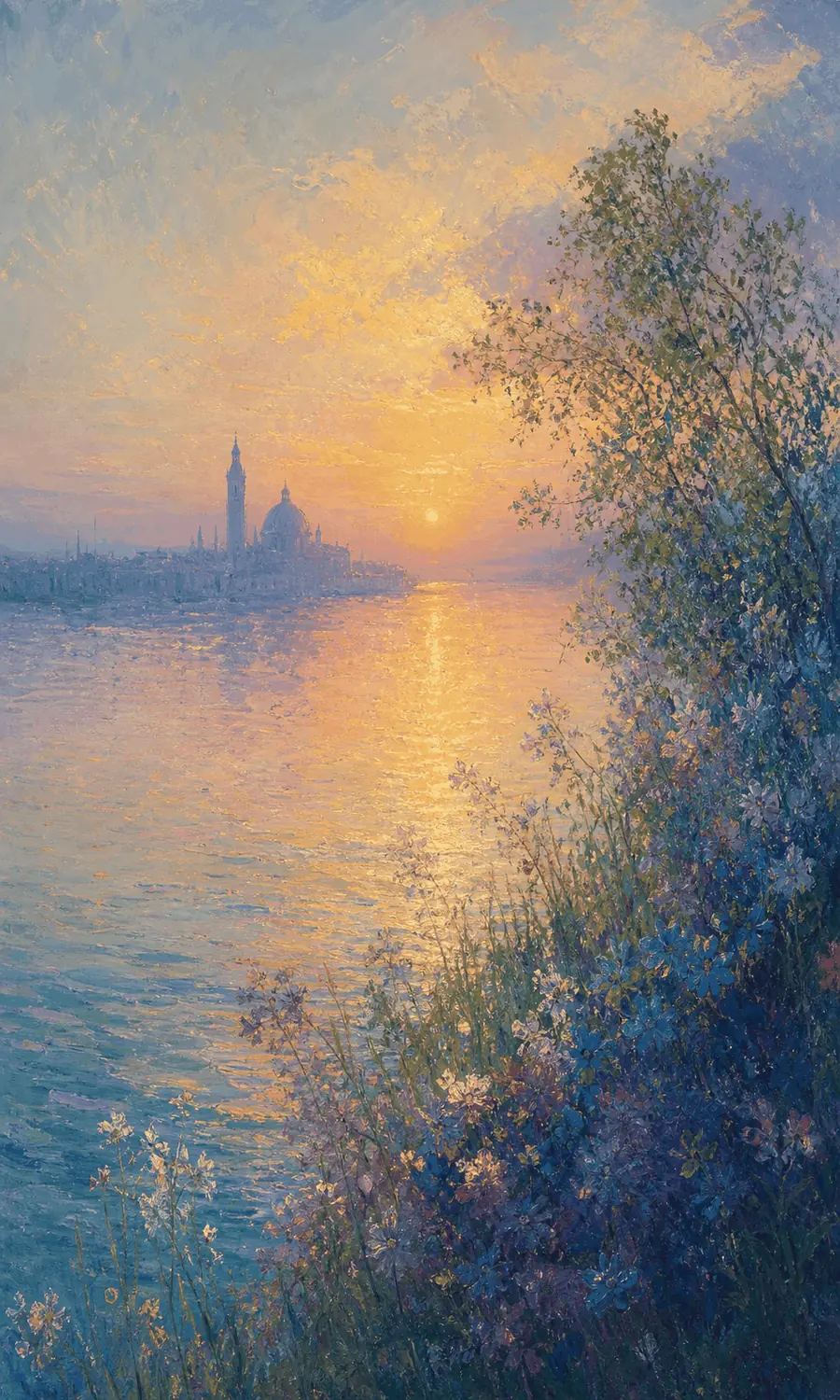
If the same place were painted again an hour later, what would change first: the object itself, or the light and air around it?
Shadows are not simply darkened but shift into blues, violets and greens, while highlights flicker through several adjacent hues.
Water, mist, snow and gardens break up edges, with strokes recording how atmosphere changes what can be seen.
The same site returns across hours, weather and seasons, turning a stable subject into a measure of changing light.
These are comparative observation levels, not ratings of artistic value or quality.
Squint slightly when reading a Monet-like image. If edges soften and colors breathe into the air, it is working.
He cared less about an object's fixed color and more about how it appears under a particular light. Fast, loose marks preserve the feeling of time passing.
Like morning light on water, painted before it has time to solidify.
Compare one wall across morning, evening, weather and curtains before assigning it a fixed color name.
Watch fabric change under daylight, tree shadow and reflected light, treating color as something produced with its surroundings.
Return to one site at different times and compare how water, mist, sky and reflection alter its edges.
See how glass, metal and wet surfaces borrow surrounding hues, revealing that object color is not always stable.
Shared qualities: Both use open brushwork, outdoor light and modern-life fragments to study momentary vision.
Different choices: Impressionism includes many artists and approaches; Monet's language is especially sustained through series, revisited sites, water, gardens, mist and reflected light.
Shared qualities: Both are associated with Impressionism and use broken strokes and bright color in outdoor light.
Different choices: Monet often turns landscape into a field for measuring time and atmosphere; Renoir more often centers figures, skin, sociability and warm moving light.
Monet-like Impressionist light, morning garden or water surface, loose short brushstrokes, misty blue pale lilac water-lily green, soft atmospheric perspective, gently dissolved edges, original landscape illustration, high resolution, not copying a specific Monet work
Avoid hard line art, photorealism, heavy black shadows, oversaturated neon, copying a specific Water Lilies or Rouen Cathedral composition
Claude Monet was central to French Impressionism in the late 19th century. He and his peers moved outside the studio to study outdoor light, weather, changing time and modern life; his late Giverny garden and water-lily series pushed light, water and color toward abstraction.
Are you seeing a fixed place, or what light has temporarily made of it at this moment?